Top 10 AC Fan Motor Options for Global Buyers in 2026?
The world of AC fan motors is evolving rapidly. In 2026, buyers will have numerous options to consider. According to industry expert Dr. Emily Walsh, "The AC fan motor market will see significant innovation and competition." Her statement underlines the importance of understanding current trends and technologies.
Choosing the right AC fan motor can significantly impact energy efficiency and performance. Factors like power consumption and noise levels play a crucial role in selection. Buyers must also consider the varying designs and specifications available today. Some manufacturers focus on sustainability, while others prioritize high performance.
As we explore the top ten AC fan motor options for global buyers in 2026, it's essential to reflect on the challenges in this industry. Diverse needs across markets mean that not every product is suitable for every application. Be prepared to research and compare to find the best fit.
Top Trends in AC Fan Motor Technology for 2026
In 2026, AC fan motor technology is set to undergo significant transformation. The focus will shift to energy efficiency and smarter features. These advancements will not only reduce energy consumption but also enhance performance. Users will appreciate quieter operation and improved airflow. Manufacturers are investing in research to meet these demands.
Tips for selecting AC fan motors include paying attention to energy ratings. A higher rating indicates better efficiency. Look for motors with innovative control systems. These can optimize performance based on environmental conditions. When evaluating options, consider the ease of installation and maintenance. Complex designs may complicate repairs.
Sustainability will also be a driving force. Many consumers seek eco-friendly solutions. Manufacturers are exploring materials and designs that minimize environmental impact. However, the transition to green technology can pose challenges. It is crucial to balance performance and sustainability. Some new technologies may lack long-term reliability. Buyers should weigh these factors carefully.
Essential Factors to Consider When Choosing AC Fan Motors
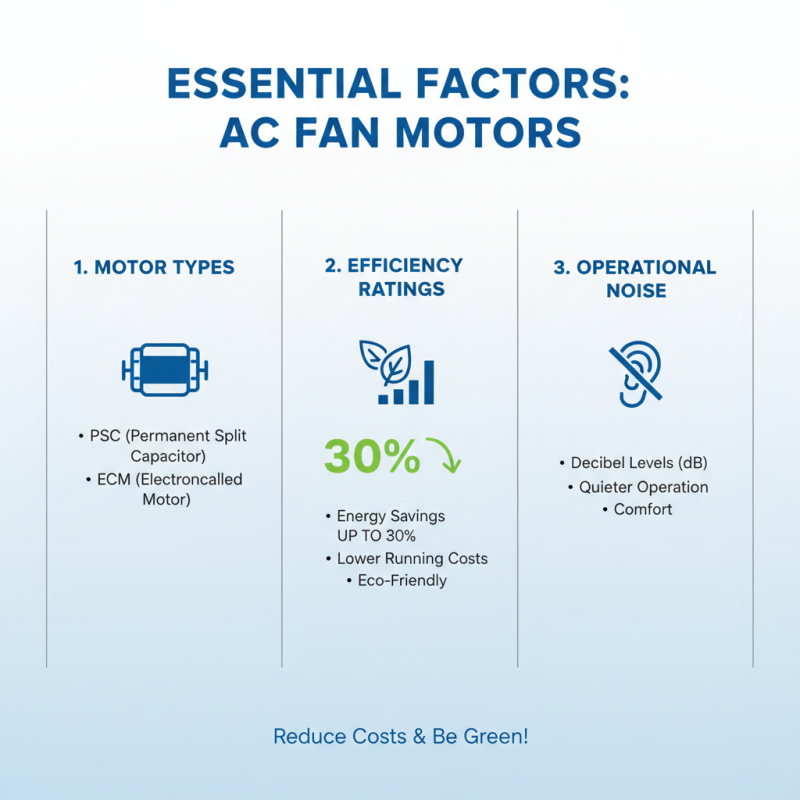
When choosing AC fan motors, several essential factors should guide your decision. Motor types, efficiency ratings, and operational noise levels are critical elements. Reports indicate that energy-efficient motors can reduce energy consumption by up to 30%. This not only decreases operational costs but also addresses growing environmental concerns.
Another factor to consider is the motor’s design and durability. Some models may require more maintenance, increasing long-term costs. Data show that motors with better thermal performance can extend their lifespan by 20%. This translates into fewer replacements and less environmental waste.
It's also crucial to evaluate the noise levels of the motor. A quieter operation may improve comfort in residential and commercial spaces. Industry surveys reveal that noise complaints can influence user satisfaction significantly. Ideally, the chosen motor should balance performance and user comfort to avoid future issues. Keep these factors in mind for a well-informed purchase decision.
Comparison of Leading AC Fan Motor Brands Available Globally
When selecting AC fan motors, it's essential to understand what sets leading brands apart. Globally, various manufacturers offer unique features. Key factors to consider include energy efficiency, noise levels, and durability. Some motors excel in quiet operation, while others focus on enhanced energy savings.
Tips: Always check the specifications before purchasing. Look for models that offer warranty coverage. This ensures long-term reliability and service.
Exploring customer reviews may provide insights into performance and longevity. Users often share their experiences with different models. Such feedback can be valuable in decision-making. It’s wise to assess the installation requirements, as these can vary significantly between different brands.
Finally, consider your specific needs. Not every motor suits every application. Understanding the environment and usage can prevent future frustrations. Each buyer's priorities are unique, making personal research essential. Trial and error may lead to better-suited choices in the long run.
Innovative Features of 2026's Best AC Fan Motors
As we approach 2026, AC fan motors are becoming increasingly sophisticated. Innovative features are shaping the market, catering to diverse consumer needs. One notable advancement is energy efficiency. Manufacturers are now developing motors that consume less power while maintaining high performance. This is crucial for reducing energy bills and promoting sustainability.
Another exciting feature is smart technology integration. Many AC fan motors are equipped with IoT capabilities. This allows users to control their fans remotely through mobile apps. Some models even learn preferences over time, adjusting speed and operation automatically. However, not every consumer feels comfortable with such high-tech solutions. User feedback is essential to ensure these features are user-friendly and reliable.
Noise reduction is also a key focus. Many 2026 models aim for quieter operation. This is an important aspect for households looking for peace and relaxation. However, the challenge remains in balancing quiet performance and cooling effectiveness. The complexity of these features can sometimes lead to maintenance issues, making reliability a concern for potential buyers. It's vital for manufacturers to address these challenges head-on to build trust with consumers.
Top 10 AC Fan Motor Options for Global Buyers in 2026
Sustainability and Energy Efficiency in Modern AC Fan Motors
The landscape of AC fan motors is rapidly changing. Sustainability and energy efficiency are becoming critical factors. Buyers in 2026 must consider these elements when selecting motors.
Modern AC fan motors are designed to consume less energy. Many use advanced materials and technology that reduce consumption. This shift not only lowers electricity bills but also minimizes environmental impact. However, there are challenges. Not every motor labeled as energy-efficient truly meets the standards. Buyers should look for verified ratings.
Reliability is another concern. Low-cost options may promise efficiency but fail in longevity. Investing in quality motors is vital. Additionally, as markets evolve, potential buyers should stay updated on new technologies. Educated decisions will lead to better choices and greater satisfaction in the long run. Embracing sustainability should not compromise quality or performance.
Top 10 AC Fan Motor Options for Global Buyers in 2026
| Rank |
Motor Type |
Power Efficiency (%) |
Sustainability Index |
Noise Level (dB) |
Price Range ($) |
| 1 |
Brushless DC |
95 |
High |
35 |
250-300 |
| 2 |
Induction Motor |
90 |
Medium |
40 |
150-200 |
| 3 |
Switched Reluctance |
92 |
High |
45 |
300-350 |
| 4 |
Universal Motor |
85 |
Low |
60 |
100-150 |
| 5 |
EC Motor |
93 |
High |
38 |
220-270 |
| 6 |
Capacitor Start Motor |
88 |
Medium |
50 |
130-180 |
| 7 |
Variable Frequency Drive (VFD) |
91 |
High |
42 |
400-500 |
| 8 |
Permanent Magnet Motor |
94 |
Very High |
37 |
350-400 |
| 9 |
Dual-Phase Motor |
86 |
Low |
55 |
120-160 |
| 10 |
Stepper Motor |
89 |
Medium |
48 |
180-230 |



 Email
Email Whatsapp
 WeChat